Harness Bench.

Explore results Follow on GitHub

The longer-term goal is to reconstruct the task × model × harness success matrix without running every cell. I will test whether success has enough low-rank structure for SVD to identify a small set of Terminal-Bench tasks that predicts the full matrix.

If that works, the reduced task panel becomes a fast screen for many more model–harness combinations which leave space to reserve full runs for combinations that look promising.
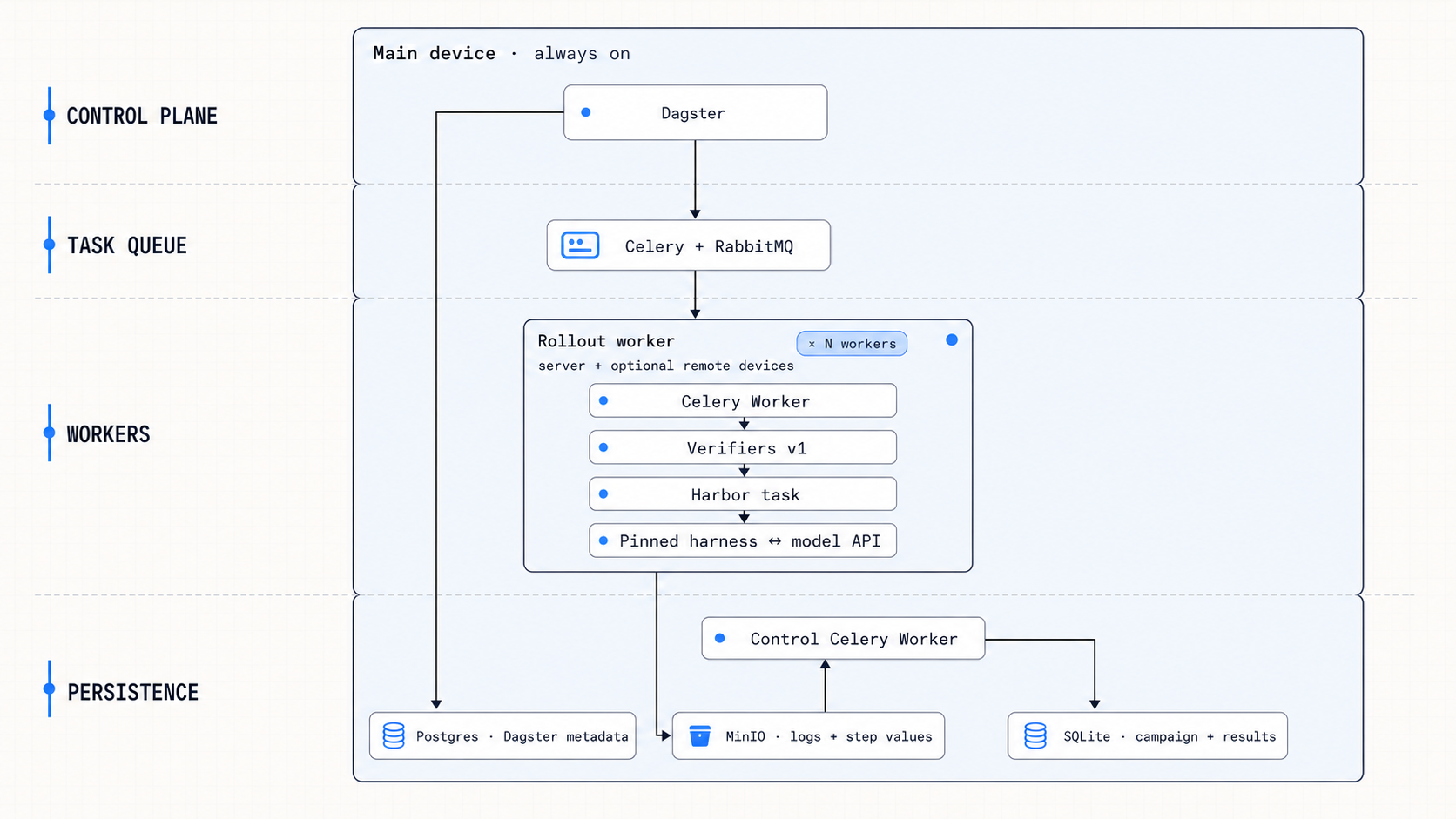
Harness Bench architecture in four layers. On the always-on main device, Dagster schedules work through Celery. The queue distributes rollouts across interchangeable server workers. Each worker runs Verifiers v1 over a Harbor task with a pinned harness connected to the model API. Dagster stores run metadata in Postgres. Rollout workers store logs in MinIO. A separate control Celery worker receives completed step values and serializes benchmark results into SQLite.

The first run held the model fixed—DeepSeek V4 Flash, high reasoning—and compared six popular harnesses over roughly 1,500 Terminal-Bench rollouts.

Harness Bench success versus cost A scatter plot comparing mean task success and mean cost for six agent harnesses.

Loading results…